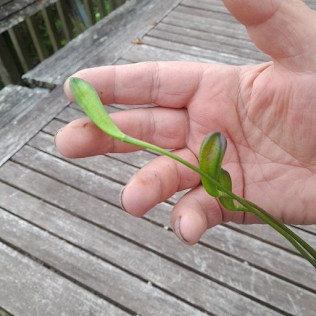
Saturday, August 24, 2024

Dahlia tubers, daylily seeds as food, and others

I tried eating the tubers of a Dahlia I found growing wild in a suburb of Wellington, New Zealand. I am not sure what species or variety it is, Dahlia coccinea x pinnata is reported to grow wild in New Zealand (1), it seems most likely to be this, photos below, let me know if you know. Both Dahlia coccinea and pinnata are edible cooked (2)  so it is safe to assume any cross between them is too.


The tubers are available in winter, I had to leave a marker in summer to find them as it goes dormant for winter so tubers can be hard to find. The plant produces an abundance of good sized tubers.


I tried them raw, they are crunchy like an apple with a slight taste of uncooked potato, but basically bland in flavor. I also boiled them. They remain crunchy after boiling with very little flavor, much like potato in taste but very different in texture. After prolonged boiling they get a bit softer but are still crunchy. I would say they have a slightly coarse texture, they also leave the mouth slightly dry I find, but they are basically okay.


I found them better roasted for 20-30 minutes, luscious in texture and more tasty, though still hard to describe.

Based on eating them once I would say they are not quite as good as more well known root crops, though a taste could possibly be acquired for them, they have been a traditional part of the diet in parts of South America (2). The fact that they are perennial, compete with weeds and require little or no care may still make them a worthwhile crop overall.    

The skin is sometimes reported to taste bad, I did not find this but it is a bit tough and can be slightly fibrous. 

The flowers of some Dahlias are also reported edible (3) these ones had little flavor but are colorful and good to eat.  

References.

1) New Zealand Plant Conservation Network. 
https://www.nzpcn.org.nz/flora/species/dahlia-coccinea-d-pinnata/

2) Food Plants in the Americas: A Survey of the Domesicated, Cultivated and Wild Plants Used for Human Food In the Americas. Brian Kermath. 2018.

https://www.academia.edu/1139225/Food_Plants_in_the_Americas_A_Survey_of_the_Domesticated_Cultivated_and_Wild_Plants_Used_for_Human_Food_in_North_Central_and_South_America_and_the_Caribbean

3)The Encyclopedia of Edible Plants of North America. Francis Couplan. 1998.


Hemerocallis middendorffii Seeds Tasty

Ainu Ethnobiology by Dai Williams 2017 reports the relatively large seeds (about .5 cm) of Hemerocallis middendorfii were once eaten by the Ainu people in Japan (https://ethnobiology.org/sites/default/files/publications/contributions/ainu-ethnobiology-final-web-01-09-2018.pdf ).

  No details on preparation are given. I tried a few, raw they are ok, but roasted for 15 minutes they taste surprisingly good, like nuts, the texture is not as good or smooth as popular nuts, a bit crumbly, but okay. Perhaps I cooked them for a bit too long. 

I am only aware of one other report of Hemerocallis seeds (in general) being edible, Eat the Weeds by Green Deane: 

https://www.eattheweeds.com/daylily-just-cloning-around-2/

he also says the pods are good to eat. 

I also tried the seeds of Hemerocallis lilioasphodelus, also about .5 cm wide, from a seed packet, I don't know for sure if they were alive or dead. I could find no ethnobotanical or other record of their being eaten, nor of their being toxic. I found after roasting at 250 C for 10-20 seconds they had a mild but distinctive and pleasant nutty taste, more like pine nuts than any other nut, texture more crumbly than crunchy, but okay. I found roasting for any longer at 250 C they tasted bad, burnt. I did not have enough to experiment with cooking at lower temperatures for longer, that might be better. 

 I could not directly compared with taste of Hemerocallis middendorffii seeds as the experiments were months apart. I think middendorfii was a bit stronger in flavor.  
     
  I infer from the pleasant taste and lack of reports of toxicity they are both safe to eat. In both cases I only had a few seeds to experiment with.

It seems likely all Hemerocallis species seeds are edible but most Hemerocallis readily available are hybrids that usually produce few or no seeds. 

It is worth noting the roots of at least one Hemerocallis species are considered toxic and the flowers of some of the thousands of hybrid varieties are thought to be slightly toxic, I have had a semi-allergic reaction to some.

Getting a reasonably large nut-like food from such a small perennial is rather rare and desirable, most nut trees are too big for the average garden. 

Lespedeza bicolor seed taste

Another seed reportedly once eaten in Japan is that of Lespedeza bicolor (bush clover). There seems to be only one reference, the seeds were boiled with rice (Tanaka's Cyclopedia of Edible Plants of the World. 1976), although I found one paper that mentioned it in a discussion of prehistoric grains (Tools to Live By. Emma Keiko Yasui 2021).

I assume from Tanaka it was used the same way as rice and could potentially be used as a substitute.

There seem to be no reports on taste so I tried a few from a seed for sowing packet (don't have access to a plant). They are a bit smaller than rice, 2-3 mm. I boiled some for 10 minutes, they were then soft, a bit softer than cooked rice, and stayed the same size as before cooking, they tasted like mild bread or wheat, not bad. Presumably they'd be firmer with briefer cooking.

I think it would be worth trying larger quantities to see if they make a good rice substitute for places where rice won't grow, although you can't help wondering if there is a good reason why it is no longer used. It appears going by photos one bush produces a lot of seeds, I don't know how quick or easy harvesting would be, that may be the problem. 


Anemone rivularis seed taste test
 
The book 'Plants and People of Nepal' by Narayan P Manandhar  (2002) reports the reasonably large (5 mm by 1 mm) seeds of the very shade tolerant plant Anemone rivularis are roasted, then pickled then eaten in Nepal. 

I tried some raw (which appeared to be alive but might not have been) they were tasteless and really too chewy but did not seem to be acrid as has been reported. I tried roasting some seeds. After less than a minute at 250 C they were no longer chewy, they were crisp, but basically tasteless if not slightly woody in flavor. Boiled for 10 minutes they were still pretty chewy and tasteless. Fried for a few minutes they were only a bit better. 

Perhaps pickling in some special way as well makes them palatable, I did not try that. It seems like an unpalatable food to me though might be nutritious being a seed.  

Cercis canadensis var. texensis mature seeds edibility

Native American Food Plants by Moerman reports American Indians once roasted and ate the seeds of Cercis canadensis var. texensis. I could find no detail on taste or preparation anywhere so tried some from a seed packet. I found roasted straight from the packet they were ghastly, like tiny tasteless pieces of hard wood. However if left to soak in water for a few days many swelled from 2-3mm in size to an almost respectable 6-8 mm. I assume the ones that didn't were dead. If then roasted or put in an air fryer they were edible but not of especially good texture, a bit hard and "bitsy", I could not really detect any taste but did not have many to try. However if boiled instead they had good smooth but firm texture and a mild but distinct and pleasant pea or bean flavor. 

It is possible roasting did not work because the seeds I tired had been stored or Indians might have harvested and roasted before full maturity.    


Thursday, February 8, 2024

Conscious Flow (art).


"Conscious Flow" by David Nicholls.

Painting completed 12/23. Acrylic on canvas.


Wednesday, January 17, 2024

Nymphaea alba petioles productive edible


The book Cross-cultural ethnobotany of Northeast India (Saklani & Jain 1994) states the petioles (leaf stalks) of Nymphaea alba (the white waterlily) are edible and are sold in markets, which suggests high food value and quality.

I find chopped and boiled very briefly the leaf stalks taste mildly of beans and have a pleasant, asparagus like texture. Not spectacular but good, I eat them often in stir fry or "stir boil".


Harvested leaves and leaf stalks are quickly replaced by new ones over spring, summer and autumn so it is a particularly reliable and productive crop (I have only been harvesting continuously like this for about 6 months, I'm not certain the plant can take this over many years but I expect it can. I also leave most of the leaves/leaf stalks alone at any one time so as not to put too much strain on the plant).


I grow it in a black plastic flexi-tub 55 cm wide. I find I can harvest the amount pictured above at least once a week from one tub which is pretty good. The black plastic raises the temperature of the water when sun is on it which may increase productivity, perhaps to subtropical levels in this temperate climate.

I have also eaten the petioles of Nymphaea odorata, probably not quite as good. Flowers, leaves rhizomes and seeds of this waterlily are considered edible (Edible & Medicinal Plants of Canada. MacKinnon et al. 2009) so I am sure the petioles are too. It is possible any Nymphaea petiole can be eaten but some may be slightly unsafe or require lengthy cooking to break down the mild toxin nupharine. I find they tend to break apart with lengthy cooking.


Wednesday, November 29, 2023

Hedychium coccinium shoots tasty


The book Cross-cultural Ethnobotany of North East India (1) says the tender shoot of Hedychium coccineum (orange gingerlily) is eaten raw or cooked by the Anals of Chandel District and is cultivated in kitchen gardens for this purpose. There are also a few brief mentions of this use online (2,3). There seem to be no record of this use in the West even though the plant is grown in gardens as an ornamental.

 
I've tried the shoots, they have a mild ginger flavor, not at all overpowering, good chopped up added to a stir fry. They have no fibers and a pleasant crisp texture. You have to peel away the inedible outer layer, this is pretty easy and quick. 
 
I tried what I think is the large variety Hedychium coccinium var angustifolium (narrow leaf ginger), purchased from Coast Palms and Cycads (New Zealand), sold as Hedychium coccinium "Lizzie". They have used the same photo on their website for this plant as used by the Pacific Bulb Society for var angustifolium. It also matches the description of angustifolium given by Branney (4). Mine have not flowered yet so I can't compare them to the photos directly.

It is not clear it is this large variety that is eaten in Asia but it tastes fine. I read somewhere there is no known toxicity in Zingiberaceae but can't find that reference now. Angustifolium is now considered a synonym of coccinium.
 
The plant grows well in Wellington, NZ, (zone 9). It got very tatty in winter, basically deciduous, but grew back fine in spring. It does not mind heavy clay soil and is fine in part shade. Its size means weeding is less essential if you hate doing that as it towers over most of them. Angustifolium is probably too big for small gardens, about 2 m tall. 

I'm not yet sure how productive it is, presumably it is reasonably productive if cultivated in kitchen gardens in India for food.


 References.

1)  Cross-cultural Ethnobotany of North East India. A Saklani. S K Jain 1994. 

2) An ethnobotanical note on wild edible plants of Upper Eastern Himalaya, India.

G. Murtem¹ and Pradeep Chaudhry

 https://www.researchgate.net/publication/305112551_An_ethnobotanical_note_on_wild_edible_plants_of_Upper_Eastern_Himalaya_India

3) Monpa, memory, and change: an ethnobotanical study of plant use in Mêdog County, South-east Tibet, China

Shan Li et al Journal of Ethnobiology and Ethnomedicine volume 16, Article number: 5 (2020)
   
https://ethnobiomed.biomedcentral.com/articles/10.1186/s13002-020-0355-7
 
4) Hardy Gingers. T.M.E Branney. Royal Horticultural Society. 2005.

Thursday, November 2, 2023

Erythronium revolutum pods taste good


The boiled green seed pods of Erythronium revolutum taste a lot like beans or peas, very good. They are also of good consistency, like beans or cucumber, and are a respectable size. It seems a little strange to me they are not more popular as a vegetable. 

I could only find one reference to these pods being edible (1) which says the pods of Erythronium species in general were "said" to taste of string beans once cooked. They do list this species specifically amongst others but other than this recent book there only seem to be two older written references to Erythronium pods being eaten, specifically those of  Erythronium grandiflorum (2). I only have access to one of these (3) it simply mentions the flavor of string beans after boiling. It is also a little strange there seem to be no reports of Native Americans eating the pods of any Erythronium, they apparently only ate the underground corms or bulbs, (including those of revolutum)(4). 

American edible plant guru Euell Gibbons says all parts of all Erythronium species are edible, but goes on to mention all parts except the pods(5). There are no confirmed reports of toxicity in any Erythronium (6) but there there is a report Erythronium americanum and Erythronium grandiflorum may be emetic (makes you vomit) despite being used as food (7), very widely in the case of grandiflorum (4). Apparently the supposed emetic effect is at high doses and only in some species (8). It is probably unknown if this effect applies to the pods, I will find out eventually probably.  

 This may be the only perennial shade loving/understory bean substitute, quite valuable in my view. I have not tried the pods of any other Erythronium.

References.

1) Edible & Medicinal Plants of Canada. MacKinnon. Kershaw. Arnason. Owen. Karst. Hamersley. Chambers. 2009.

(Couplan also mentions the seed pods of Erythronium species "reportedly" being eaten without mentioning revolutum (The Encyclopedia of Edible Plants of North America. 1998.) )

2)   https://pfaf.org/user/Plant.aspx?LatinName=Erythronium+grandiflorum

3)  A field Guide to Rocky Mountain Wildflowers. Craighead, Craighead, Davis. 1963. 

4) Native American Food Plants. Moerman. 2010. 

5) Euell Gibbons' Handbook of Edible Wild Plants. Gibbons. Tucker. 1979.

6) International Poisonous Plants Checklist. An Evidence-based Reference. Dr J Wagstaff. 2008.

7) https://www.academia.edu/1139225/Food_Plants_in_the_Americas_A_Survey_of_the_Domesticated_Cultivated_and_Wild_Plants_Used_for_Human_Food_in_North_Central_and_South_America_and_the_Caribbean

8) https://www.cultivariable.com/instructions/root-crops/trout-lily-erythronium-spp/

Friday, August 25, 2023

Vietnamese mint most productive crop


Vietnamese mint (Polygonum odoratum) has been the most productive perennial crop I've grown in Wellington, New Zealand (hardiness zone 9), I've tried hundreds of crops (still looking for other crops as productive and hassle free). I've found just one Vietnamese mint in the right spot will spread in a year or two to form a patch around 2 meters wide, it will then stop expanding. These patches repress most or all weeds, even outcompeting the dreaded Tradescantia fluminensis. It can be viewed as a groundcover around 1 m tall.

I've found I can harvest one of these patches to get enough for a decent salad most days of the week year round, new leaves keep being reproduced. I've found they need reasonably moist soil in half shade to be productive like this, clay soil is fine. It will grow on steep slopes as long as there is deep soil. It will survive dryer and sunnier spots but will not be nearly as productive. Finding the right spot may require some trial and error.

Most sources say harvest the younger leaves, older leaves are "too tough" or "too peppery". I've gotten used to eating the large older leaves, they probably require a bit more chewing but I like them most of all, probably for their luxuriant appearance and because they can be harvested more quickly or easily. I agree with advice that the leaves are not good to eat if they turn red but this hardly ever happens to mine, perhaps because of the mild climate. I find the leaves need to be eaten immediately after harvest, they deteriorate quickly if stored, they are also no good cooked in my opinion.  

The flavor is delicious and interesting in my opinion but not liked by everyone, it is mildly hot and peppery. It is good uncooked mixed in with a stir fry, or in a salad. The plant is said to reduce sexual drive, this is completely false in my experience.